

- 12 Sections
- 93 Lessons
- 10 Weeks
Expand all sectionsCollapse all sections
- Chapter 1INTRODUCTION OF BEEF BUTCHERY5
- Chapter 2INTRODUCTION TO DIFFERENT SECTIONS OF A SLAUGHTER HOUSE OR AN ABATTOIR5
- Chapter 3CATTLE SLAUGHTER IN MODERN ABATTOIRS34
- 3.1Overview
- 3.2Introduction
- 3.3Cattle Receiving
- 3.4Holding at Lairage and Ante-Mortem Inspection
- 3.5Stunning
- 3.6Ex- Sanguination (Sticking/Bleeding)
- 3.7Shacking and Hoisting
- 3.8Hide Washing
- 3.9Electrical Stimulation
- 3.10Removal of Foot and Shank
- 3.11Leg Steam Vacuuming/ Blow- Off
- 3.12Free Leg Hang-Off (Transfer to Trolley)
- 3.13Second Leg Hang-Off
- 3.14Fore Foot Removal
- 3.15Hide Removal
- 3.16Head Removal
- 3.17Tongue Removal
- 3.18Head and Tongue Washing
- 3.19Head and Tongue Inspection
- 3.20Steam Vacuuming Stations
- 3.21Pre-Evisceration Washing
- 3.22Tie and Separation of Weasand
- 3.23Bung Bagging, Tying and Separation
- 3.24Tail Removal
- 3.25Brisket Sawing
- 3.26Evisceration
- 3.27Spinal Cord Removal
- 3.28Final Trimming
- 3.29Final Post-Mortem Inspection
- 3.30Hot Fat Trimming and Measurement of Hot Carcass Weight
- 3.31Final Interventions
- 3.32Carcass Chilling, Primal Cutting and Packing
- 3.33Reference ( Image )
- 3.34Quiz 530 Minutes13 Questions
- Chapter 4MANUAL ON BUTCHERY TECHNIQUES : BASICS12
- 4.1Introduction to the Manual on Butchery Techniques: Basics
- 4.2Overview
- 4.3Sections :- 1
- 4.4Sections :- 2. Muscle and Carcass Structure
- 4.5Sections :- 3. Slaughterhouse (Abattoir) Structure and Sections
- 4.6Sections :- 4. Slaughter Procedures
- 4.7Sections :- 5. Carcass Cutting and Portioning
- 4.8Sections :- 6. Meat Processing and Preservation
- 4.9Sections :- 7. Food Hygiene and Worker Safety
- 4.10Sections :- 8. Muscle to Meat Conversion
- 4.11Conclusion
- 4.12Quiz 610 Minutes15 Questions
- Chapter 5MANUAL ON BUTCHERY TECHNIQUES: BASICS11
- 5.1Introduction to the Chapter
- 5.2Overview
- 5.3Module 1: Introduction to Butchery and Meat Terminology
- 5.4Module 2: Anatomy and Muscle Structure
- 5.5Module 3: Slaughterhouse Layout and Equipment
- 5.6Module 4: Slaughter and Dressing Operations
- 5.7Module 5: Carcass Cutting and Portioning
- 5.8Module 6: Cold Storage and Meat Preservation
- 5.9Module 7: Food Hygiene and Safety Practices
- 5.10Module 8: Review and Certification
- 5.11Quiz 710 Minutes13 Questions
- Chapter 6Basic Terminology for Cattle and Meat Classification5
- Chapter 7Classification of Meat by Animal Source.4
- Chapter 8Meat Components and Carcass Parts4
- Chapter 9Basic Anatomy and Connective Tissue6
- Chapter 10Personal Hygiene and Work Attire4
- Chapter 11Sections of an Abattoir7
- Chapter 12Pre-Slaughter Section8
Sections
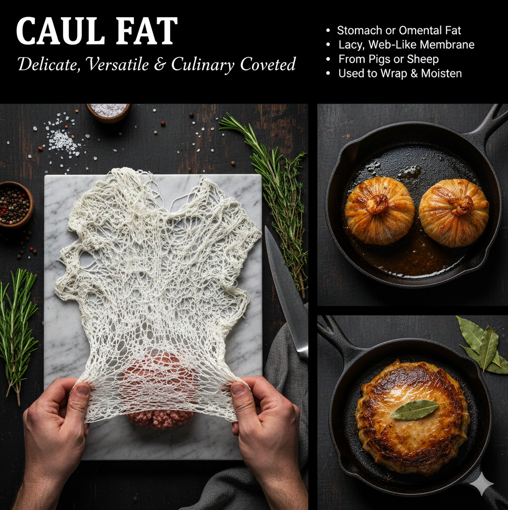
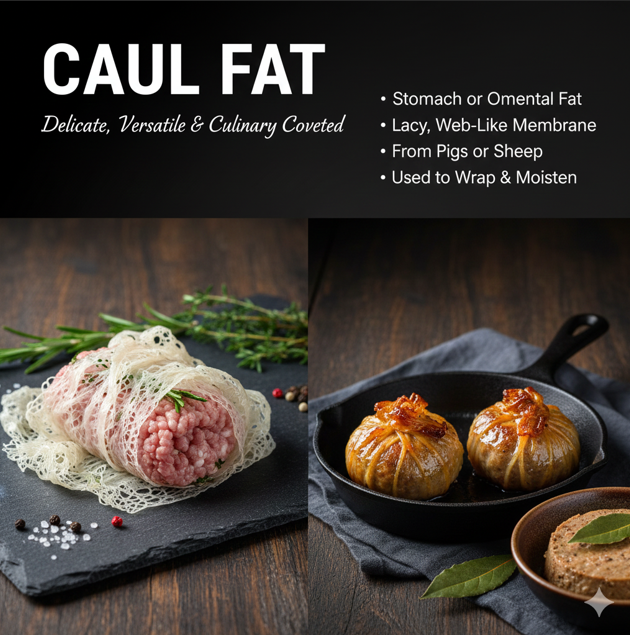
1. Caul Fat
Definition: The stomach or omental fat. It is a delicate, lacy membrane of fat surrounding the stomach and other internal organs, primarily from pigs or sheep. Relevance to Butchery: Caul fat is highly prized for culinary uses. It is often used to wrap lean cuts of meat or ground mixtures (like pâté, faggots, or sausages) to keep them moist during cooking, melt away easily, and add flavor.
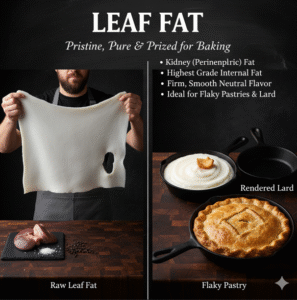
2. Leaf Fat
Definition: The kidney fat (or perinephric fat) that surrounds the kidneys, typically obtained from pigs. Relevance to Butchery: Leaf fat is considered the highest grade of internal fat, particularly from pigs. It is firm, smooth, and has a neutral flavor. It is highly valued for rendering into lard or shortening for baking, as it produces the flakiest pastries and is virtually odorless.
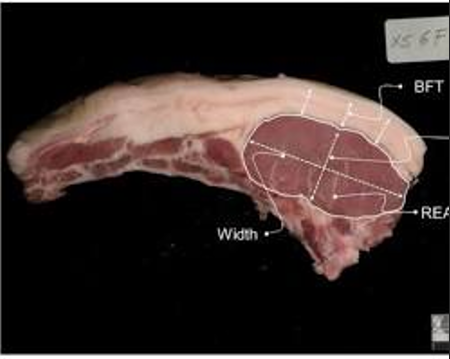
3. Cutting Fat
Definition: Back fat (subcutaneous fat) found immediately beneath the skin of an animal, most commonly referenced in pigs. Relevance to Butchery: Cutting fat is the primary external fat source used in meat processing. It’s often utilized in products like sausages, ground meats, and forcemeats to control the fat content and add moisture and flavor. It is distinct from leaf fat (internal) in that it is harder and less uniform.
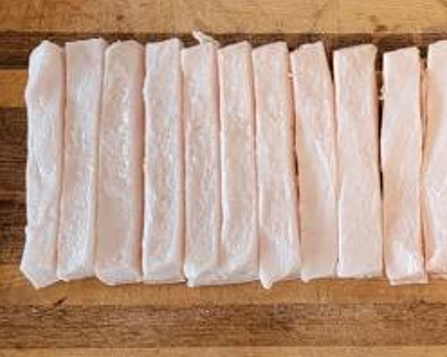
4. Seam Fat
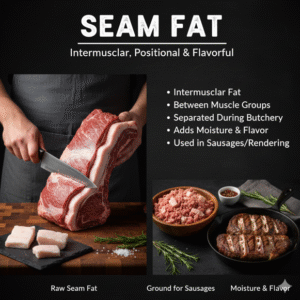
Definition: Intermuscular fat—the visible fat deposits found between individual muscles or muscle groups. Relevance to Butchery: Seam fat is generally separated during the deboning and portioning process, defining the boundaries between different cuts (sub-primals). While usually trimmed away from retail cuts, it can be utilized in sausage making or rendered for other culinary fats.
5. Marbling
Definition: Intramuscular fat—the fine streaks or flecks of fat deposited within the lean muscle tissue itself. Relevance to Butchery: Marbling is the single most important factor in determining the quality grade of meat (e.g., USDA Prime, Choice). As the meat cooks, this fat melts, lending the meat its juiciness, tenderness, and flavor. Higher marbling usually indicates higher-quality beef cuts.


6. Sweetbread (Thymus)
Definition: An edible offal consisting of the thymus gland (also known as the throat or neck sweetbread) and sometimes the pancreas (stomach sweetbread), typically sourced from calves (veal) or lambs.
Relevance to Butchery: Sweetbread is considered a delicacy in haute cuisine. As a glandular organ, its preparation is specialized: it must be thoroughly cleaned, soaked, and often blanched (parboiled) before being pan-fried or braised. The veal thymus is generally the most prized variety.

7. Carcass
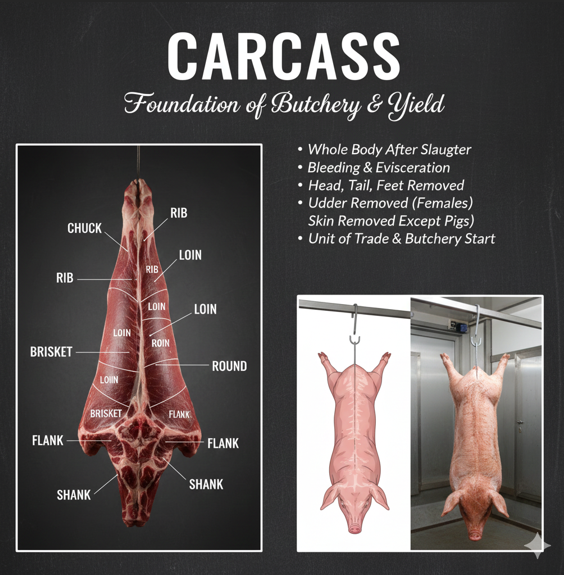
Definition: The entire body of a food animal that remains after the initial slaughter process. This includes the whole body following bleeding, evisceration (removal of internal organs), and the removal of the head, tail, udder, and the distal extremities of the limbs (feet) at the carpus and tarsus. The skin is also removed, with the notable exception of pigs, where the skin (rind) is usually left on.
Relevance to Butchery: The carcass is the unit of trade and the starting point for all subsequent butchery operations. Its preparation and initial chilling are crucial as they directly impact the hygiene, safety, and ultimate quality (tenderness and yield) of all primal and retail cuts.
8. Offal
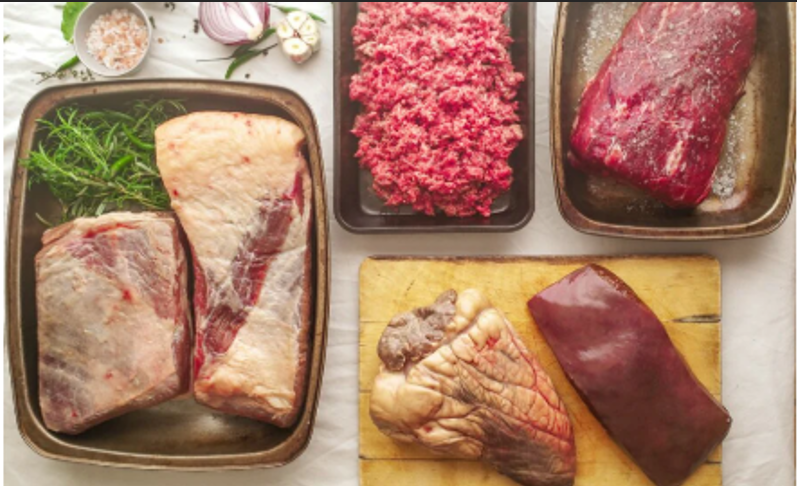
Definition: Consists of all parts of the animal that are not part of the carcass as it leaves the slaughter area. This category is broadly divided into edible and inedible parts.
Types and Relevance to Butchery:
- Edible Offals (Variety Meats): These are valuable non-carcass parts used for human consumption. Examples include the heart, liver, tongue, head meat, and tripe (stomach lining). They are essential products in many ethnic and traditional cuisines.
- Inedible Offals: These parts must be handled separately and typically enter rendering or other industries. Examples include the hide (skin), hair, contents of the digestive tract, and certain glands. Their management is critical for abattoir hygiene and profitability.
- Address: INDIA
- Hours: Mon-Fri 9:00AM - 5:00PM
- Phone: +97433455629
- Email: info@precisionbutchery.com
© copyright blisstechinfo