

- 12 Sections
- 93 Lessons
- 10 Weeks
Expand all sectionsCollapse all sections
- Chapter 1INTRODUCTION OF BEEF BUTCHERY5
- Chapter 2INTRODUCTION TO DIFFERENT SECTIONS OF A SLAUGHTER HOUSE OR AN ABATTOIR5
- Chapter 3CATTLE SLAUGHTER IN MODERN ABATTOIRS34
- 3.1Overview
- 3.2Introduction
- 3.3Cattle Receiving
- 3.4Holding at Lairage and Ante-Mortem Inspection
- 3.5Stunning
- 3.6Ex- Sanguination (Sticking/Bleeding)
- 3.7Shacking and Hoisting
- 3.8Hide Washing
- 3.9Electrical Stimulation
- 3.10Removal of Foot and Shank
- 3.11Leg Steam Vacuuming/ Blow- Off
- 3.12Free Leg Hang-Off (Transfer to Trolley)
- 3.13Second Leg Hang-Off
- 3.14Fore Foot Removal
- 3.15Hide Removal
- 3.16Head Removal
- 3.17Tongue Removal
- 3.18Head and Tongue Washing
- 3.19Head and Tongue Inspection
- 3.20Steam Vacuuming Stations
- 3.21Pre-Evisceration Washing
- 3.22Tie and Separation of Weasand
- 3.23Bung Bagging, Tying and Separation
- 3.24Tail Removal
- 3.25Brisket Sawing
- 3.26Evisceration
- 3.27Spinal Cord Removal
- 3.28Final Trimming
- 3.29Final Post-Mortem Inspection
- 3.30Hot Fat Trimming and Measurement of Hot Carcass Weight
- 3.31Final Interventions
- 3.32Carcass Chilling, Primal Cutting and Packing
- 3.33Reference ( Image )
- 3.34Quiz 530 Minutes13 Questions
- Chapter 4MANUAL ON BUTCHERY TECHNIQUES : BASICS12
- 4.1Introduction to the Manual on Butchery Techniques: Basics
- 4.2Overview
- 4.3Sections :- 1
- 4.4Sections :- 2. Muscle and Carcass Structure
- 4.5Sections :- 3. Slaughterhouse (Abattoir) Structure and Sections
- 4.6Sections :- 4. Slaughter Procedures
- 4.7Sections :- 5. Carcass Cutting and Portioning
- 4.8Sections :- 6. Meat Processing and Preservation
- 4.9Sections :- 7. Food Hygiene and Worker Safety
- 4.10Sections :- 8. Muscle to Meat Conversion
- 4.11Conclusion
- 4.12Quiz 610 Minutes15 Questions
- Chapter 5MANUAL ON BUTCHERY TECHNIQUES: BASICS11
- 5.1Introduction to the Chapter
- 5.2Overview
- 5.3Module 1: Introduction to Butchery and Meat Terminology
- 5.4Module 2: Anatomy and Muscle Structure
- 5.5Module 3: Slaughterhouse Layout and Equipment
- 5.6Module 4: Slaughter and Dressing Operations
- 5.7Module 5: Carcass Cutting and Portioning
- 5.8Module 6: Cold Storage and Meat Preservation
- 5.9Module 7: Food Hygiene and Safety Practices
- 5.10Module 8: Review and Certification
- 5.11Quiz 710 Minutes13 Questions
- Chapter 6Basic Terminology for Cattle and Meat Classification5
- Chapter 7Classification of Meat by Animal Source.4
- Chapter 8Meat Components and Carcass Parts4
- Chapter 9Basic Anatomy and Connective Tissue6
- Chapter 10Personal Hygiene and Work Attire4
- Chapter 11Sections of an Abattoir7
- Chapter 12Pre-Slaughter Section8
Preventing Contamination Through Proper Dressing and Conduct
This lesson emphasizes that the meat handler (the butcher) is a critical point in the food safety chain.1 Strict personal hygiene and the correct use of protective clothing (PPE) are non-negotiable requirements to prevent the transfer of biological and physical hazards to meat products.
2. How to Dress (The Standard Work Attire)
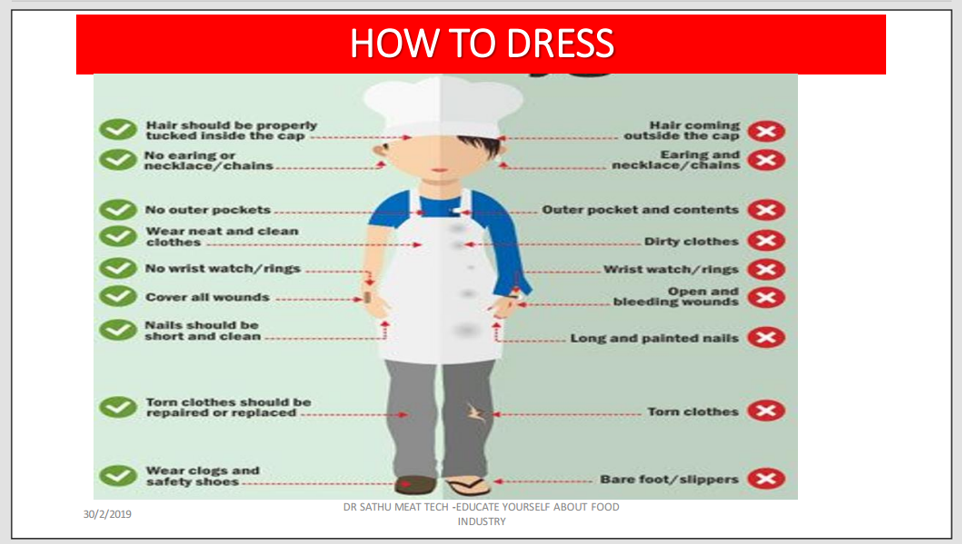
Proper work attire, often referred to as Personal Protective Equipment (PPE), creates a physical barrier between the worker and the product.
- Head Cover (Cap/Hairnet): Must fully contain all hair and, for men, cover the beard if one is present.4 Prevents hair (a physical contaminant) from falling into the product.
- Protective Coat/Apron: Typically a light-colored (white) coat or heavy waterproof apron. This protects the worker’s street clothes from soiling the product and is often made of material that is easy to wash and sanitize.
- Gloves: Worn over clean hands. Gloves are not a substitute for washing and should be changed frequently and immediately if they become torn or contaminated.5
- Boots (Footwear): Must be waterproof, closed-toe, and non-slip.6 They must be cleaned and sanitized before entering and upon leaving the processing area.
- Masks (Optional/Required): Used to prevent the transfer of droplets/saliva to the product, especially during close-contact processing.
3. Analysis of Visuals (Image Principles)
The images provided illustrate key standards of professional attire and facility control in food processing:
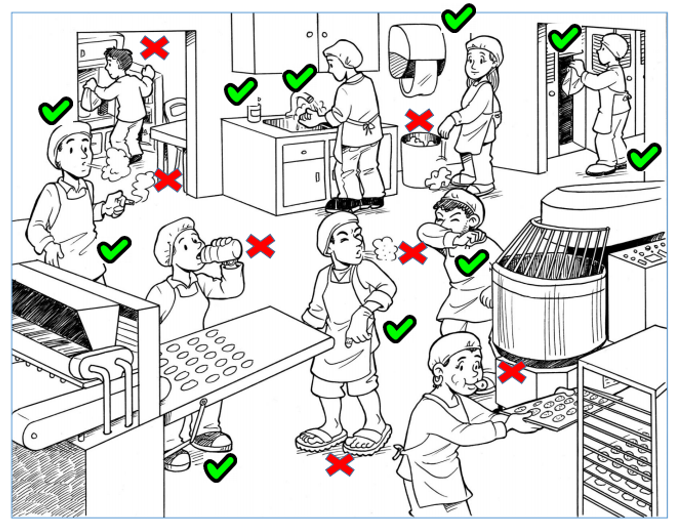
- White and Light-Colored Clothing: The standard butcher’s wear (aprons, coats) is white or light in color.
Principle: Light colors instantly reveal dirt, blood, or contamination, prompting immediate action by the worker.
- Structured Head/Hair Cover: Workers are shown wearing full caps or hairnets.
Principle: Enforcing the absolute containment of hair to eliminate it as a physical contaminant.
- Clean and Dedicated Footwear (as implied): Workers are shown in the controlled environment of the facility.
Principle: Dedicated, washable footwear is used to prevent the tracking of dirt and bacteria from outside areas (or “dirty” zones of the plant) into the “clean” processing areas.
- Professional, Orderly Environment: The workers and environment appear neat and organized.
Principle: Strict adherence to personal hygiene protocols is a reflection of the overall high standards of sanitation and discipline required in the entire meat processing environment.
- Address: INDIA
- Hours: Mon-Fri 9:00AM - 5:00PM
- Phone: +97433455629
- Email: info@precisionbutchery.com
© copyright blisstechinfo